How it works
How a case moves, and who decides
One journey from the first enquiry to steady support, with the human decision points marked in amber. Nothing is handed off into a void, and every notification has a named owner and a clock.
Prototype design · synthetic data only
The case journey
Nine stages. Aria does the groundwork in eight of them; a named human owns the decision in the one that matters most.
-
00
Enquiry and registration
Any channel, any hour. Acknowledgement in under one hour.
-
01
Triage and duty
Risk screen, tiering and routing. Urgent means immediate.
-
02
Advice and prevention
Resolved or stepped up — never a dead end.
-
03
Assessment
s.9, carer, OT, CHC and MCA/DoL routes, drafted as conversations.
-
04
Eligibility decision
A human decision, recorded with reasons and appealable.
Human decision -
05
Care and support planning
Co-produced plan, indicative budget and contingency.
-
06
Brokerage and commissioning
Transparent choices, provider matching, commitments recorded.
-
07
Delivery and 24/7 monitoring
Check-ins, early warnings, and a human responding to every alert.
-
08
Review and closure
s.27 reviews, outcomes measured, return route explained.

Notifications
Twenty notification types, each with an owner and a clock
Most failures in care are not decisions made badly — they are hand-offs that nobody owned. Every notification below names the receiving team, the required timing, and the escalation route if nothing happens.
| Ref | Trigger | Goes to | When | If nothing happens |
|---|---|---|---|---|
| N1 | New contact registered | Duty lead · case management | Immediate | Duty manager after 1 working day |
| N2 | Urgent risk identified | Duty lead · service manager | Immediate | On-call manager after 30 minutes |
| N3 | Safeguarding concern | Safeguarding lead / team | Immediate | Safeguarding adults board, per policy |
| N4 | Assessment completed | Practitioner caseload · case management | Same day | Team manager after 2 working days |
| N5 | Financial assessment indicated | Finance (charging team) | With assessment | Finance lead after 5 working days |
| N6 | Care package committed | Finance · BI | At commitment | Finance lead, weekly review |
| N7 | Provider referral | Brokerage · provider (consent-based) | Same day | Brokerage after 2 working days |
| N8 | CHC or health joint need | ICB liaison · GP / community nursing | Same day | ICB liaison after 2 working days |
| N9 | Deprivation-of-liberty indicators | DoLS / LPS team | Immediate | DoLS manager, same day |
| N10 | IMCA or advocacy need | Advocacy service | 1 working day | Practice lead after 2 days |
| N11 | Complaint received | Complaints team · service manager | 1 working day | Complaints lead after 2 days |
| N12 | Performance data event | BI · performance | Daily batch | BI lead, weekly |
| N13 | Statutory return data | BI · DASS office | Per cycle | Head of BI at T-10 days |
| N14 | Market or capacity signal | Commissioning | Monthly | Commissioning lead, monthly |
| N15 | Hospital admission or discharge | Hospital social work · discharge team | Immediate | Discharge lead, same day |
| N16 | Housing need identified | Housing partners | 2 working days | Housing lead, weekly |
| N17 | Transition (16–25) | Children's services · transitions lead | At identification | Transitions lead, monthly |
| N18 | Carer crisis | Carer services · duty lead | Immediate | Duty manager, same day |
| N19 | Model incident (AI output) | Carely.care practice lead · PSW | Within 1 hour | Programme board, by severity |
| N20 | Provider failure or quality concern | Commissioning · safeguarding if risk | Immediate | Commissioning lead, same day |

Case states
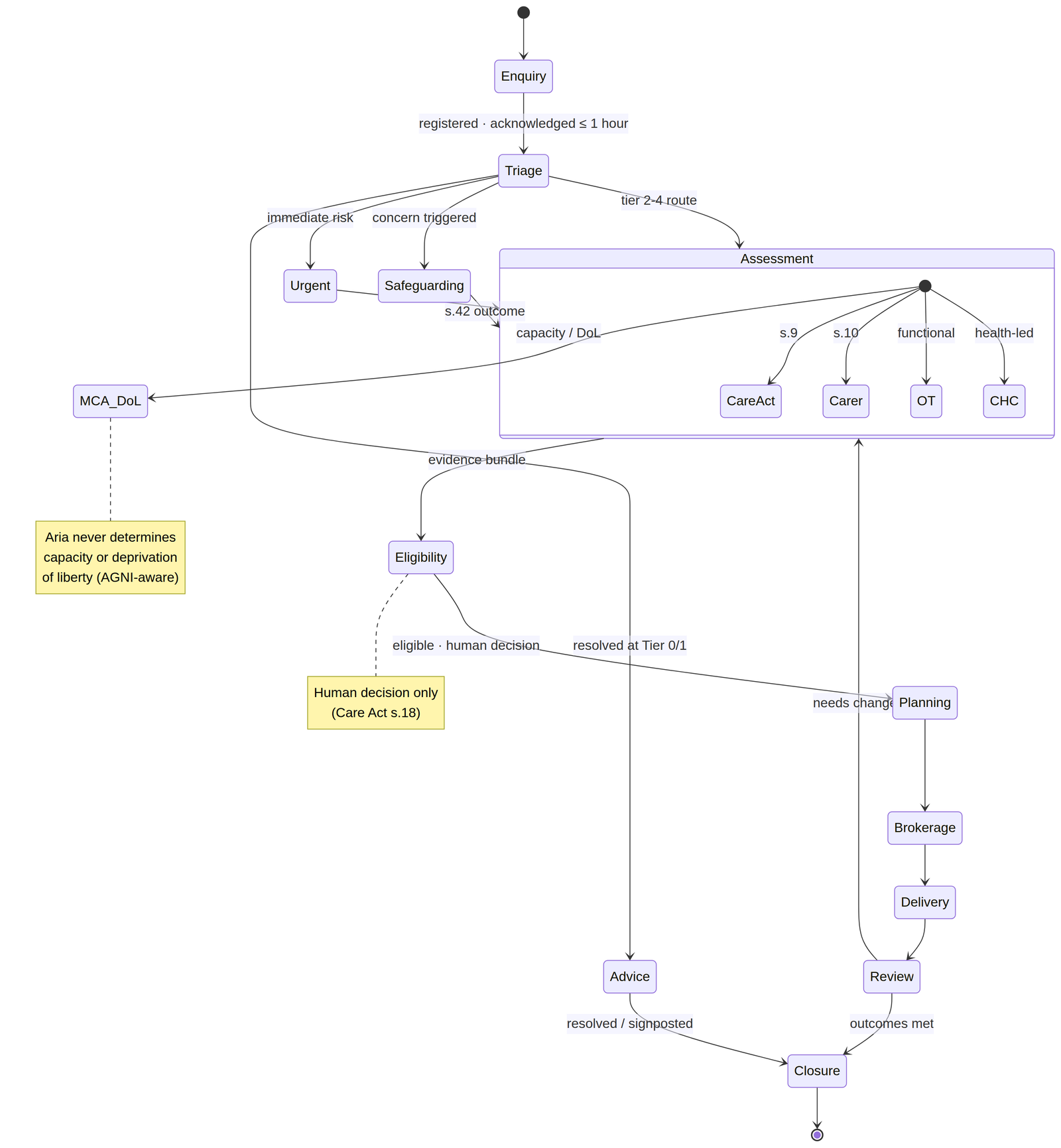
Where a case can be, and what happens next
Every case sits in one of a small number of states. That single fact is what makes “where is my case?” answerable, and what makes a stalled case visible before it becomes a complaint.
Transitions are logged with the reason, the responsible team and the timescale — so the audit trail explains not only what happened, but why.
- Enquiry received and acknowledged within the hour
- Triage complete, with risk screen and tier
- Assessment conversation complete and drafted
- Eligibility decision recorded by a human, with reasons
- Plan agreed, budget indicated, contingency named
- Support in place and monitored around the clock
- Review due, or case closed with a route back in
Want to see this mapped onto your own pathways?
We will bring the workflow to a session with your duty, assessment and commissioning leads — and map it honestly against what you already run.