Information and advice
Plain-language information about rights, processes and prevention options, 24/7 and in accessible formats (Care Act s.4).
The platform
Everything a person, a carer, a practitioner or a commissioner needs — designed as one conversation rather than twenty systems. Each capability states plainly what Aria does and who decides.
Synthetic data only · prototype status · statutory decisions always remain with a human
Showing all 20 capabilities. The filter uses JavaScript; every capability is listed in full either way.
Plain-language information about rights, processes and prevention options, 24/7 and in accessible formats (Care Act s.4).
Structured triage with risk screening and tiering, routing to the right service with a human decision and an override log.
Proportionate, strengths-based s.9 assessment conversations, drafted for practitioners to complete and own.
s.10 carer assessment support: sustainability, contingency, respite and support options — offered by default, not on request.
Functional pre-assessment, equipment and adaptation options, reablement goals. The OT decides; Aria prepares.
Safe moving-and-handling information and assessment booking, with an assessor signing off every plan.
Supported decision-making, capacity assessment routes and AGNI-consistent deprivation-of-liberty indicators. Never a determination.
CHC checklist evidence preparation and joint assessment support. The ICB decides eligibility.
Co-produced plans, outcomes, indicative personal budgets and contingency planning.
Provider search and matching by needs, location, quality and price, with transparent pricing, messaging and interviews.
Capacity and demand signals, market-shaping data and referral-quality standards for commissioners.
Scheduled check-ins, early-warning alerts and a consent-based family dashboard. Humans respond to every alert.
Twenty notification types across finance, BI, health, housing and safeguarding — each with a named owner and a clock.
Proactive updates at every step — letters, SMS, email, easy-read — so nobody is left wondering what happens next.
“Where is my case?” answered instantly, with the next step, the responsible team and the timescale.
Intake, routing and acknowledgement, with independent signposting to the Local Government and Social Care Ombudsman.
Immediate concern capture and escalation under Making Safeguarding Personal. Aria never investigates and never judges.
PIP, Attendance Allowance, Carer’s Allowance and Universal Credit criteria explained. The DWP decides, not us.
Operations, performance, assurance and benefits dashboards; QA sampling support; CQC evidence library; statutory return support.
Posts or imports to any required system — API, FHIR-aligned health flows, CSV or JSON, or human in the loop with an audit note.
How it fits together
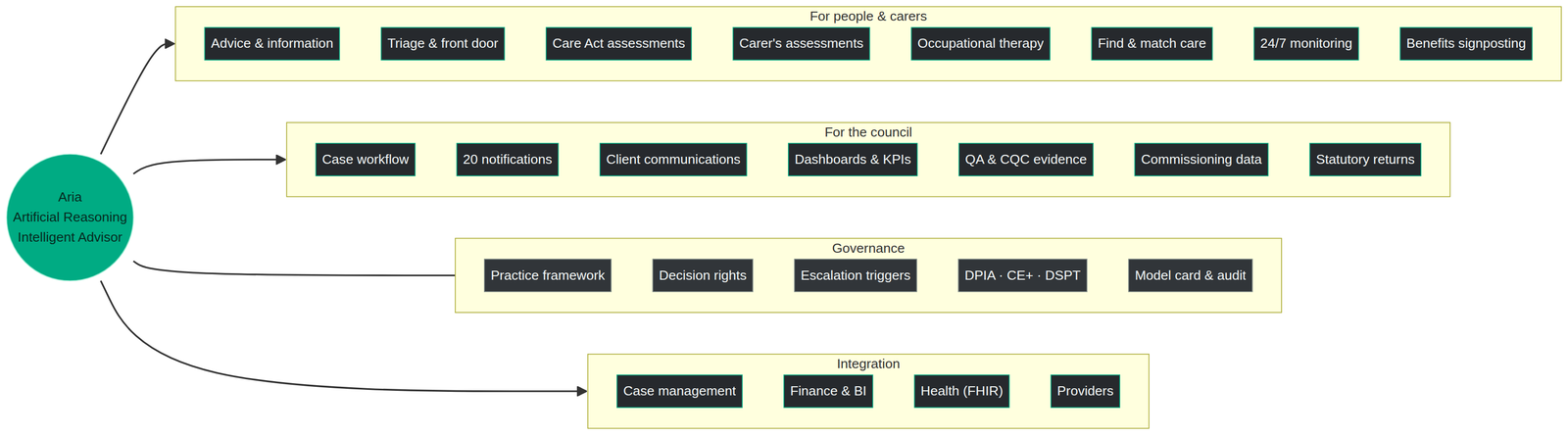
Aria sits at the front. Behind it, every capability posts to the system that already owns the work — with an audit note, or a human in the loop where the risk demands it.
Designed in the open
Software in adult social care is held to a higher standard than software almost anywhere else. We think the way to earn that trust is to say exactly what the system does, what it refuses to do, and who is accountable when it is wrong.
That is why every capability above states the human decision it supports, and why the safeguards page publishes the escalation triggers and the incident controls — including the ability to pause the model.
Tell us the one that matters, and we will show you exactly how it works in a pilot.